Regenerative Orthopedics in Wellington, FL for Sports and Everyday Joint Pain

Pain has a way of becoming the center of the schedule. A knee that used to tolerate riding, walking, golf, or pickleball now swells after activity. A shoulder that once handled lifting, grooming, tennis, or barn work now aches at night. A tendon near the elbow, heel, hip, or kneecap keeps flaring every time life gets busy. At first, many Wellington patients work around it. Then the workaround becomes the routine.

Regenerative orthopedics in Wellington, FL is often appealing because it suggests there may be a thoughtful middle ground between ignoring pain and moving directly toward surgery. For some patients, options such as platelet-rich plasma may be considered as part of a non-surgical plan. For others, the better answer may be physical therapy, bracing, medication changes, imaging, or a surgical consultation. The right path depends on the diagnosis, not on the popularity of a treatment.

That is the most important point. If you finding “Regenerative orthopedics near me”  this should be patient-benefit-first and evidence-aware. It should help people understand their condition, protect function, and make realistic choices.

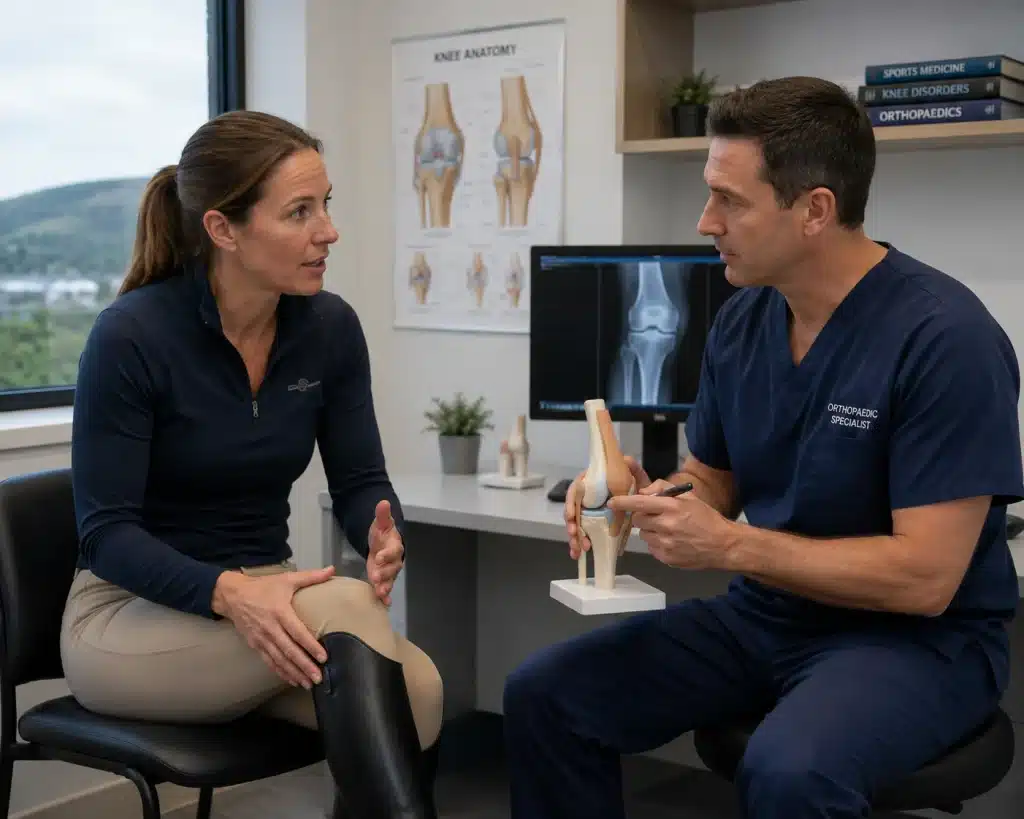
Wellington FL regenerative orthopedics consultation for knee and sports-related joint pain.

What Regenerative Orthopedics Is Trying to Do

Regenerative orthopedics focuses on treatments designed to support the body’s healing environment in injured or irritated musculoskeletal tissue. PRP, one of the best-known options, is made from a patient’s own blood. The blood is drawn, processed to concentrate the platelet-rich portion, and then injected into the target area. Platelets contain growth factors and biologic signals involved in healing responses.

AAOS OrthoInfo describes PRP as a preparation that has been studied for orthopedic injuries, while also noting that evidence depends on the condition being treated. Mayo Clinic Orthopedics and Sports Medicine describes regenerative medicine procedures including PRP, where a patient’s own platelets are isolated and concentrated before being injected into the injured area. Johns Hopkins Medicine explains that PRP has gained attention for sports injuries and chronic tendon problems that can be slow to recover.

For patients, the takeaway should be balanced. PRP may be useful for selected problems, but it should not be promised as a universal fix. A good regenerative orthopedic plan starts with the question, “What tissue is injured, and why is it not recovering?”

Wellington Activity Patterns Matter

Wellington has a distinct rhythm. Some patients are deeply involved in equestrian activity, barn work, training, and seasonal schedules. Others are active with golf, tennis, pickleball, fitness classes, walking, gardening, work, caregiving, or travel. Many people are managing pain while still trying to meet responsibilities that cannot simply pause.

That local context matters because orthopedic care should connect to real life. A patient who rides may need hip, knee, ankle, and core function in ways that differ from a patient focused on golf or tennis. A patient doing barn work may be lifting, carrying, stepping on uneven ground, and repeating tasks that challenge tendons and joints. A patient trying to keep up with everyday errands may care most about walking distance, stairs, sleep, and confidence.

Regenerative orthopedics in Wellington, FL should be built around those details. The goal is not just less pain in a clinic room. The goal is better movement where life actually happens.

Conditions That May Lead Patients to Ask About PRP

PRP is commonly discussed in relation to chronic tendon pain and certain joint pain patterns, especially when symptoms have not improved enough with basic conservative care. A Wellington patient might ask about PRP for knee osteoarthritis, rotator cuff tendinopathy, tennis elbow, golfer’s elbow, Achilles tendinopathy, plantar fascia pain, patellar tendon pain, hip tendon irritation, or other soft-tissue overload conditions.

The possible list is broad, but the decision should be narrow. A painful shoulder may involve tendon irritation, bursitis, arthritis, stiffness, neck referral, or a tear. A painful knee may involve arthritis, meniscus irritation, ligament injury, kneecap tracking, or referred pain. A painful heel may involve plantar fascia, Achilles insertion, nerve irritation, or stress injury.

When patients skip diagnosis and shop for a treatment first, they risk spending time and money on the wrong tool. The better path is to identify the pain generator and then decide whether PRP belongs in the plan.

Palm Beach Regenerative Orthopedics evaluation for tendon and joint pain.

What a Good Consultation Looks Like

A careful consultation should feel thorough, not rushed. The clinician should ask when symptoms started, what activities trigger pain, whether there was an injury, what treatments have already been tried, whether pain wakes the patient at night, and what the patient needs to return to. These answers help separate a stubborn but treatable overload problem from a structural issue that may need different care.

The physical exam should be specific to the area. For a knee, that may include swelling, range of motion, alignment, stability, strength, gait, and meniscus or kneecap testing. For a shoulder, the exam may include range of motion, rotator cuff strength, impingement signs, neck screening, and scapular mechanics. For tendon pain, the clinician may test loading, tenderness, stiffness, and weakness.

Imaging may be recommended. X-rays help evaluate arthritis and bone alignment. Ultrasound can show some tendon problems and may be used to guide injections. MRI may be needed if the diagnosis remains uncertain or if a tear, cartilage injury, or deeper structural problem is suspected.

Why Regenerative Orthopedics Is Not Just an Injection

The injection may be the easiest part to describe, but it is not the whole treatment. The tissue still needs the right recovery environment. A knee with arthritis needs strength and load management. A tendon needs progressive loading and time. A shoulder needs mechanics, mobility, and gradual return to work or sport. A hip may need core and glute strength, gait changes, and attention to repetitive strain.

If the same overload pattern continues, symptoms may return even after a technically well-performed injection. This is why a serious regenerative orthopedic plan should include aftercare, activity guidance, and a plan for measuring progress. The patient should know what to avoid, what to continue, when to restart exercise, and when to follow up.

For Wellington patients with busy schedules, that guidance can be the difference between recovering thoughtfully and accidentally provoking the same tissue again.

What Happens During PRP Treatment

PRP treatment usually begins with a blood draw. The blood is placed into a centrifuge, which separates components so the platelet-rich portion can be prepared. The clinician then injects the PRP into the target joint or tissue. Depending on the condition, image guidance such as ultrasound may be used.

Afterward, patients may be told to limit certain activities for a period of time. Some soreness can occur. Improvement is typically not immediate. A reasonable plan should explain the expected timeline, what symptoms are normal, what symptoms should prompt a call, and how rehab fits into recovery.

Patients should also ask about medication guidance. In some protocols, anti-inflammatory medications may be limited around the time of PRP because the treatment is intended to influence a healing response. Instructions vary, so patients should follow their clinician’s specific plan.

Image-guided PRP planning for regenerative orthopedics in Wellington FL.

No. Many cases improve with nonsurgical care such as splinting, activity change, exercises, and sometimes corticosteroid injection.

AAOS notes that stiffness and locking often worsen after inactivity, which is why symptoms are commonly more noticeable when you wake up.

If the finger cannot be straightened with gentle manipulation, medical evaluation becomes more important because surgery may be recommended to prevent permanent stiffness.

Yes. When the thumb is involved, the condition is commonly called trigger thumb.

Patricia Y. profile picture
Patricia Y.
2 years ago
I saw Dr Al-Rashid for a painful hip in 2023. I was at a point where I had to use my hands to “lift” my leg into the car because the pain was too intense to just lift it on its own. He said that I was a candidate for PRP (platelet rich plasma) injections because I still have cartilage. Although they are not (yet) covered by insurance, it was an investment in my comfort that I am very happy with. It has been over a year, I have no pain whatsoever and can carry out my normal routine, and increased my exercise. I highly recommend Dr Al-Rashid and the Atlantis Orthopedic Group in Palm Beach Gardens.
Susan K. profile picture
Susan K.
2 years ago
Wonderful caring doctor.Effecient and kind staff
Jeff L. profile picture
Jeff L.
2 years ago
My medical experience with Dr. AlRashid and his staff was sensational during my two total hip replacement surgeries. Their treatment and care is top-notch and I would highly recommend them for anyone who is looking for a professional and caring Orthopedics service!
miken profile picture
miken
2 years ago
Always outstanding! He did my wife’s hip a little over a year ago and the follow up was great. I need two knee replacements and went to him to look at them. I will start with the first one end of this month. The staff follow through as been excellent. The best news is he does surgery at Palms West Hospital.
Md R. profile picture
Md R.
2 years ago
I recently had the pleasure of being under the care of Dr. Al Rashid, and I can confidently say that my experience was nothing short of excellent. From the moment I walked into his office, I was greeted warmly by the staff, and the efficiency of the administrative process was impressive. Dr Al Rashid took time to listen attentively to my concerns and thoroughly explained the treatment options available to me. His dedication to providing personalized care was evident in every interaction I had with him. I wholeheartedly recommend Dr. Al Rashid to anyone in need of a skilled and compassionate Knee specialist.
Rodney E. profile picture
Rodney E.
2 years ago
My first time to the office all staff were professional and nice, showed me that they really cared about me. Dr. Alrashid really impressed me after doing research on him he demonstrated professionalism, skill and knowledge just from our first meeting. I feel confident he will get me back to where I need to be.
Aiden profile picture
Aiden
3 years ago
I had my right hip replaced by Dr. Rashid and he was excellent. The operation went smoothly. I didn't even feel the prosthetic when I woke up from surgery.

Before all of this he was very careful and helpful, explaining everything in detail from beginning to end, even tried a few treatments before jumping into an operation.

(injections/pills/scans etc)

He explained the pros and con very well. His staff is excellent in the Loxahatchee and Lake Worth office. I'm very happy I found him. My leg feels superior than my normal leg and it's only been three weeks. The incision was tiny, and after seeing him three weeks after the operation (today), the prosthetic is perfectly in place. I barely have any pain other than wound aches from the muscle incision, which of course is healing every single day.

I no longer feel any electrical surges on my leg, spasms, or the leg not waking up when I'm in a sitting position or sleeping. Literally feels perfect. I have nothing negative to say, would definitely recommend him to everybody. I like the fact that he was very detailed with everything from beginning to end.

He takes his job very seriously well being relatable and is not the type of doctor that jumps into an instant operation, unless absolutely needed, which is positive.

Red Flags and Timing

Not every ache needs urgent care, but certain symptoms should move the appointment up. Sudden inability to bear weight, major swelling after injury, locking, buckling, fever, redness, severe night pain, loss of strength, numbness, or pain after a fall should be evaluated promptly. Chronic pain that slowly limits activity also deserves attention, even if it does not feel dramatic.

Many patients wait because they can still function. The problem is that functioning around pain can create compensation. A sore knee changes walking mechanics. A painful shoulder changes lifting. A tender Achilles changes stride. Over time, the body starts solving one problem by creating another. Earlier evaluation can help prevent that chain reaction.

Five Bottom-of-Funnel Questions

You may be a fit if your diagnosis, imaging, exam findings, and goals suggest that PRP or another regenerative option may reasonably support improvement. Fit depends on tissue quality, severity of injury, medical history, prior treatments, and whether the painful structure can respond to non-surgical care.

Schedule an appointment when pain persists, keeps returning with activity, causes swelling or weakness, interrupts sleep, limits riding or sports, or makes ordinary movement feel unreliable. Prompt evaluation is important for sudden severe pain, instability, locking, or major loss of function.

The process begins with a diagnosis-focused consultation. If PRP is appropriate, blood is drawn, processed to concentrate platelets, and injected into the target area. The clinician should provide aftercare instructions, activity limits, and a follow-up plan.

Outcomes vary. Some patients experience less pain and better function over time, while others need a different treatment. A realistic goal may be improved activity tolerance, better sleep, reduced flare-ups, and a clearer plan for long-term joint or tendon care.

If pain is changing how you move, it is worth addressing. Waiting may allow compensation, stiffness, weakness, and irritation to build. Early evaluation can help determine whether non-surgical care is still appropriate and whether regenerative orthopedics belongs in the plan.

The Bottom Line for Wellington Patients

Palm Beach Regenerative Orthopedics in Wellington, FL can be a valuable option for selected patients, but it should never be separated from diagnosis, expectations, and recovery planning. PRP may help some tendon and joint problems, but it is not a universal answer. The best care is honest about uncertainty, careful about candidacy, and practical about the patient’s real life.

If pain has started shaping your schedule, it is time to stop guessing. A focused orthopedic evaluation can clarify the source of symptoms and help you understand whether regenerative care, rehabilitation, imaging, medication changes, or another approach makes the most sense. The right plan should help you move forward with confidence, not confusion.

Location
&
Directions

Palm Beach Regenerative Orthopedics

Palm Beach Regenerative Orthopedics provides advanced, physician-led pain management care in Wellington, Florida. Under the leadership of board-certified orthopedic surgeon Dr. Mamun Alrashid, the practice focuses on regenerative therapies designed to relieve pain, restore mobility, and support lasting joint health.