If the inside of your elbow has started aching when you grip a coffee mug, lift a bag, swing a club, carry tools, or flex your wrist against resistance, it makes sense to search for golfers elbow treatment sebring, florida palm beach regenerative orthopedics. Despite the name, golfer’s elbow is not limited to golfers. It often shows up in people who repeat gripping, wrist flexion, forearm rotation, or lifting motions often enough that the tendon on the inside of the elbow gets irritated and worn down over time.
At Palm Beach Regenerative Orthopedics, the goal is to help patients in Sebring understand what may be driving inner elbow pain and what treatment path makes sense before the problem settles into a long cycle of flare-ups. The Hand to Shoulder Solution podcast episode on golfer’s elbow and the AAOS OrthoInfo review both describe the same core issue: tendon overload at the medial epicondyle, often from repetition, overexertion, or poor recovery rather than one dramatic injury.
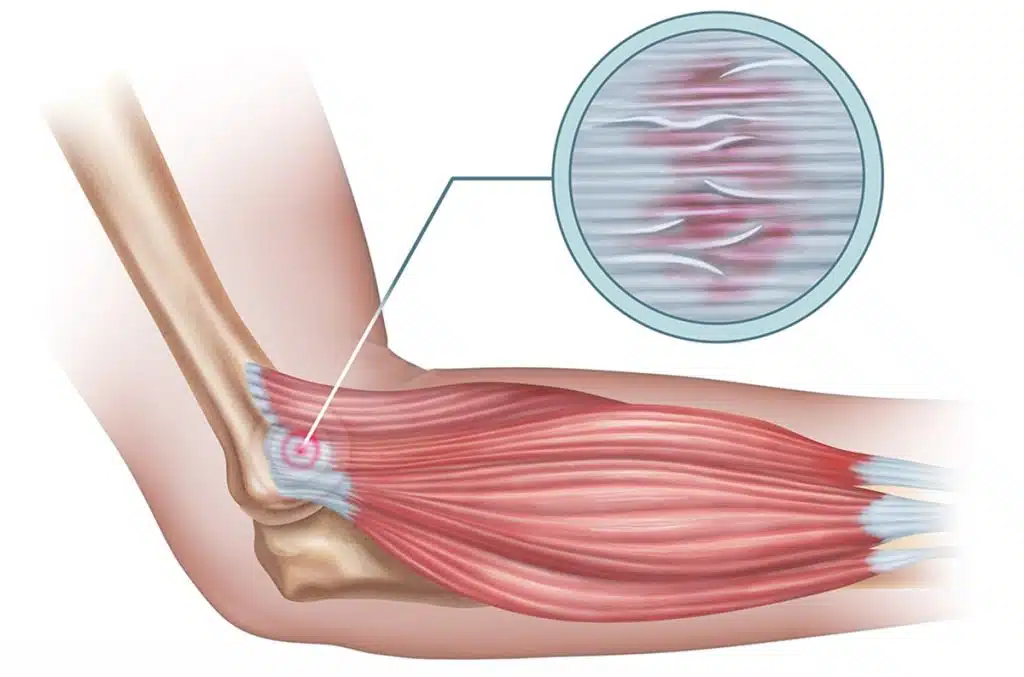
Golfer’s elbow is also called medial epicondylitis. AAOS explains that it affects the tendons of the forearm muscles that attach to the inside of the elbow at the medial epicondyle. These muscles help rotate the forearm inward and flex the wrist and fingers, which means they are involved in more daily activity than most people realize.
The AAOS review notes that one of the most commonly affected muscles is the pronator teres, although several tendons in the same region can be involved. That helps explain why symptoms can feel diffuse at times. One patient points to one sharp spot near the inner elbow. Another feels pain spreading toward the forearm when gripping, lifting, or twisting. Someone else mainly notices weakness and reduced confidence in the arm.
The podcast source makes the condition easy to picture in real life. If every time you grip tightly or turn the palm downward you keep pulling on the same irritated tendon attachment, the tissue never really gets a chance to settle. In Sebring, that can happen during golf, racquet sports, weight training, repetitive household chores, mechanical work, landscaping, warehouse lifting, or ordinary daily routines that keep loading the same structures.
A lot of patients hesitate to take the diagnosis seriously because they think, I do not even play golf. But AAOS is clear that many activities can cause medial epicondylitis, including overhead throwing, tennis, weightlifting, repetitive daily tasks, and non-sport activities with no single obvious injury.
That is important because people who do not identify with the label golfer’s elbow often keep brushing symptoms off. They assume it is just a minor strain or that it will settle if they ignore it for a week or two. Sometimes it does ease briefly. But if the same tendon keeps getting loaded by the same tasks, symptoms often come right back.
The real issue is not whether you swing a club. It is whether the tissues on the inside of the elbow are being stressed faster than they can recover.
Symptoms usually build gradually. AAOS notes that medial epicondylitis often becomes more noticeable over weeks to months rather than starting with one dramatic event. That gradual build is part of why people often wait too long to address it.
Common symptoms can include:
The podcast source uses very normal examples that make the condition feel less abstract, such as pain with gripping a coffee mug or lifting a grocery bag. That tracks with real life. Many people do not seek help because elite performance is limited. They seek help because common tasks start feeling annoyingly sharp, weak, or unreliable.
AAOS explains that with overuse or overexertion, the tendons of the forearm muscles can partially tear and wear down over time. Repetitive motions gradually create tendon injury near the medial epicondyle. This is not always a dramatic inflammatory event. Often it is repeated mechanical stress that the tissue stops tolerating well.
That helps explain why the condition can show up in a wide range of people. A golfer may develop it from swing mechanics or repetitive practice. A weightlifter may feel it during pulling work or gripping-heavy sessions. A worker may feel it from tools, lifting, or repeated pronation and wrist flexion. A non-athlete may notice it after chores, cleanup projects, or repetitive daily activities that never seemed like a problem until the tendon was already irritated.
The podcast also warns that certain forms of compression or self-treatment can make matters worse if they put pressure on already sensitive nerves and bony areas. That is a useful reminder that not every popular elbow sleeve or internet fix is automatically helpful.
One reason medial epicondylitis can be stubborn is that the arm is hard to truly rest. Even if someone stops golf or gym work, they still use the hand and forearm to open doors, carry bags, type, cook, clean, drive, and perform dozens of little motions that keep loading the irritated area.
Another challenge is that the elbow often feels almost manageable, right up until a certain movement sets it off again. People will say, it only hurts with this one motion, but that one motion keeps happening all day long. They adapt by changing how they grip, how they lift, or how they swing, and that sometimes creates new strain elsewhere in the forearm, shoulder, or wrist.
This is also why short rest periods can disappoint people. A few easier days may calm things temporarily, but if the underlying load pattern is unchanged, the tendon often flares again as soon as normal demands resume.
A good evaluation is not only about confirming that the inside of the elbow is tender. It is also about confirming that golfer’s elbow is really the right diagnosis and not part of a bigger elbow or nerve problem.
AAOS says an evaluation often includes questions such as:
The physical exam may include:
That matters because the ulnar nerve runs just behind the medial epicondyle. AAOS notes that some patients with medial epicondylitis also develop ulnar nerve irritation, which can add numbness, tingling, or radiating symptoms into the ring and pinky fingers. That changes the clinical picture and can affect what treatment should prioritize.
Imaging is not always needed immediately, but it can help when symptoms are persistent, the diagnosis is unclear, or another problem needs to be ruled out. AAOS notes that X-rays are commonly ordered to make sure there is not a fracture or arthritis in the elbow.
Ultrasound or MRI may be used to confirm the seriousness of the tendon injury or to rule out other conditions with similar symptoms, such as an ulnar collateral ligament injury. EMG studies may be ordered when nerve compression is a concern, especially in patients with symptoms of ulnar nerve irritation.
In practical terms, imaging is helpful when the case is not behaving like a straightforward tendon overload problem. If symptoms have been going on for a long time, if the pain pattern is unusual, or if numbness is part of the story, the next step may need more clarity than symptoms alone can provide.
AAOS emphasizes that most cases of medial epicondylitis can be treated effectively without surgery. That is usually where treatment should begin, especially when the symptoms are tied to repetitive overload rather than a more severe injury.
Non-surgical care may include:
The big idea is not to do nothing. It is to reduce the type of stress that keeps aggravating the tendon while building the tissue back up carefully.
The podcast source makes a useful point that not every effective strategy has to be complicated. Sometimes the best early moves are simpler than people expect, including temporary unloading, cold exposure, better stretching, better brace selection, and changing how activities are performed.
That may sound basic, but simple changes can matter a lot when they reduce repeated pulling on the irritated tendon. A slightly different grip position, fewer aggravating repetitions, less force through the wrist flexors, or a short-term pause from one painful movement can create the breathing room needed for rehab to start working.
The problem is that many people try a simple treatment for too short a time, then jump back into the exact movement that caused the issue. That creates the impression that nothing works, when really the tendon never got a fair recovery window.


AAOS describes exercise as a main treatment for medial epicondylitis. Early on, the goal is restoring full, pain-free wrist movement. After that, strengthening becomes more important, especially wrist flexion and pronation work, along with eccentric loading.
This matters because the tendon needs more than pain relief. It needs a path back to tolerating force. If the tissue is always protected but never rebuilt, symptoms may return as soon as activity increases. If it is loaded too aggressively too soon, symptoms can flare again.
A structured program can help restore motion, improve grip confidence, build forearm tolerance, and reduce the chance that the same activity pattern simply triggers another episode. For many patients, that is the difference between recurring elbow pain and a steadier recovery.
AAOS notes that a counterforce brace may limit force through the injured tendons, while a wrist brace can rest the muscles and tendons involved. Those tools can help, but they are not magic. Their value depends on whether they actually reduce the painful stress pattern without creating new irritation.
Steroid injections may sometimes be considered, but AAOS also notes that research suggests they may lengthen rehabilitation and contribute to worsening tendon damage over time. That does not make them universally wrong, but it means the tradeoffs should be taken seriously.
AAOS also lists platelet-rich plasma, dry needling, and extracorporeal shock wave therapy as other nonsurgical options that may help stimulate healing, though it remains unclear how effective they are compared with a strong stretching and strengthening program. In other words, newer or more advanced treatments may have a role, but they are not a shortcut around good rehabilitation.
Surgery is typically reserved for patients whose symptoms fail to improve after several months of recommended nonsurgical treatment. AAOS describes surgery as involving debridement of the damaged portion of the tendon near the medial epicondyle, sometimes with repair or anchor-based reattachment depending on how much healthy tissue remains.
If ulnar nerve symptoms are also present, nerve decompression or transposition may sometimes be performed during the same procedure. That is another reason it is important to diagnose the whole problem clearly rather than reducing everything to tendon pain alone.
Even when surgery is appropriate, recovery still takes time. AAOS notes that strengthening usually begins around 6 to 8 weeks after surgery, with return to normal activities or sports often taking 3 to 6 months.
Most people are not asking for a textbook explanation of the medial epicondyle. They want answers to questions like:
Those are the right questions because they focus on function, timing, and what changes the day-to-day reality of the problem.
If inner elbow pain keeps showing up, if grip strength feels less dependable, or if wrist flexion and lifting tasks are becoming frustrating, it is worth getting evaluated. The longer a person spends bouncing between random braces, internet tips, short rest periods, and repeated flare-ups, the easier it is to lose momentum and confidence.
The next step does not automatically mean a procedure. It can simply mean getting a clearer diagnosis, understanding whether the tendon alone is involved or whether the ulnar nerve is also irritated, and building a treatment plan that actually matches the way the arm is being used. For many patients, that clarity is what finally breaks the cycle.
Golfer’s elbow can begin as a mild nuisance and slowly become the reason gripping, lifting, training, and daily activity feel unreliable. Golfers elbow treatment in Sebring should focus on identifying the true pain driver, reducing the repetitive stress that keeps irritating the inner elbow, restoring motion and strength, and using the least invasive treatment path that fits the real problem. Many patients improve well without surgery when the condition is addressed before it becomes a long-standing cycle of tendon irritation and nerve sensitivity.
If pain on the inside of your elbow is not settling down, call Palm Beach Regenerative Orthopedics or schedule a visit online for a clear next step. golfers elbow treatment Sebring, Florida.
Palm Beach Regenerative Orthopedics provides advanced, physician-led pain management care in Sebring, Florida. Under the leadership of board-certified orthopedic surgeon Dr. Mamun Alrashid, the practice focuses on regenerative therapies designed to relieve pain, restore mobility, and support lasting joint health.