
As a Board-certified physician practicing orthopedic and regenerative medicine in Wellington and the greater Palm Beach County area, I evaluate patients every week with chronic joint pain, progressive stiffness, and limitations from Osteoarthritis, prior injuries, and cartilage loss.
Many of these individuals are not ready for joint replacement surgery or may not yet need it. For carefully selected patients, Stem cell therapy and related biologic procedures may be considered as part of a structured, evidence-informed treatment plan.
This page is designed to provide balanced, medically accurate information about:
- Stem cell joint injection
- Non-surgical joint treatment
- Regenerative medicine therapy
- Who may — and may not — be appropriate candidates
- Risks, regulatory considerations, and realistic expectations
Understanding Joint Degeneration
- Osteoarthritis (degenerative joint disease)
- Cartilage degeneration (progressive cartilage breakdown)
- Joint inflammation (synovial inflammatory condition)
- Prior Sports injuries (activity-related joint damage)
Joint pain commonly develops from:
- Knee osteoarthritis (degenerative knee cartilage)
- Hip pain related to degenerative hip symptoms
- Shoulder pain from glenohumeral joint pathology
In Wellington and throughout Palm Beach County, I most often treat:
- Persistent swelling
- Stiffness with activity
- Aching at night
- Decreasing walking tolerance
- Reduced athletic performance
As cartilage thins and inflammation increases, patients may experience:
Highly Experienced & Trained Orthopedic Clinic in Wellington FL
Patient Centered Care You Can Trust
What Is Stem Cell Therapy for Joints?
Stem cells are part of what we refer to as core regenerative biologic cells — cells capable of supporting tissue repair and signaling.
In orthopedic practice, we do not use embryonic cells. Instead, we use Autologous biologic material, meaning patient-derived cell source harvested from your own body.
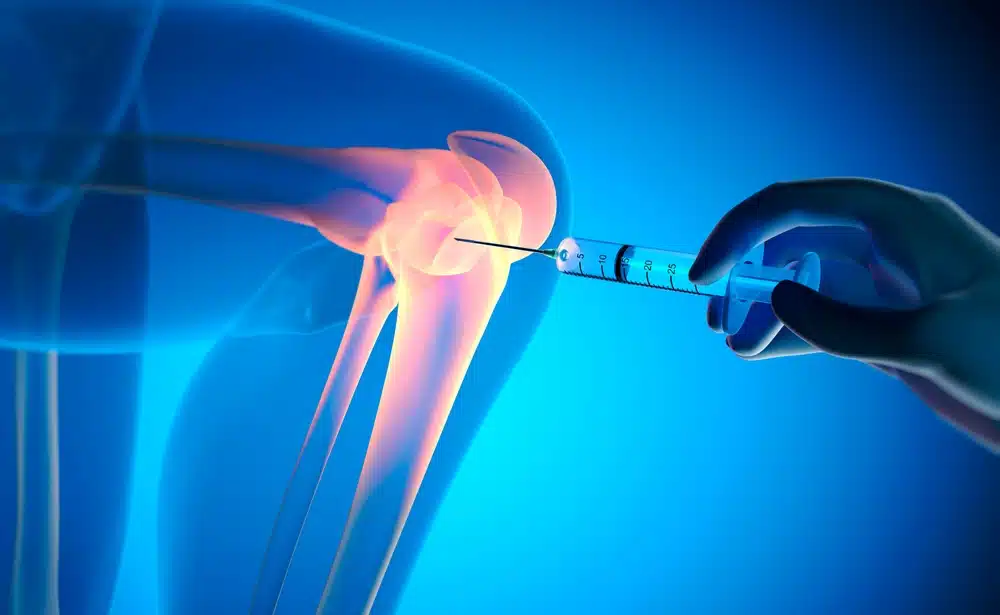
A Stem cell joint injection is a form of intra-articular biologic injection, delivered directly into the affected joint using image-guided joint injection techniques for precision.
This approach falls under the broader category of Regenerative medicine therapy, sometimes described as an orthobiologic treatment model.
Types of Orthobiologic Treatments We Discuss
1. Bone Marrow Aspirate Concentrate (BMAC)
- Bone marrow aspirate concentrate (BMAC)
- Also called concentrated marrow-derived cells
This involves a Bone marrow aspiration procedure (marrow harvest technique), typically from the posterior pelvis. The aspirate is processed using a centrifuge system (biologic concentration processing) to isolate a concentrated cellular fraction.
The final preparation is injected into the joint using:
- Ultrasound guidance (real-time injection imaging), or
- Fluoroscopy guidance (X-ray guided injection)
Strict sterile processing protocols and contamination prevention standards are followed.
2. Adipose-Derived Stem Cells
- Adipose-derived stem cells
- Also called fat-derived regenerative cells
These are obtained through an Adipose tissue harvest procedure (fat tissue extraction), typically via a small-volume liposuction technique.
Like bone marrow-derived preparations, the tissue undergoes processing before being used for injection.
3. Platelet-Rich Plasma (PRP)
- Platelet-rich plasma (PRP)
- Also referred to as platelet concentration biologic
- Delivered as PRP injection therapy (platelet-based injection treatment)
PRP does not contain stem cells but provides concentrated growth factors. In some patients, PRP may be appropriate before considering marrow-based biologics.
Who May Be a Candidate?
In my clinical experience treating Palm Beach patients, reasonable candidates for a Non-surgical joint treatment approach often include:
- Mild to moderate Knee osteoarthritis
- Early degenerative hip symptoms
- Chronic shoulder pain from cartilage or tendon pathology
- Patients seeking a conservative regenerative approach
- Individuals who have failed physical therapy, medications, or standard injections
In my clinical experience treating Palm Beach patients, reasonable candidates for a Non-surgical joint treatment approach often include:
- Have remaining joint space on imaging
- Are not bone-on-bone end-stage degeneration
- Understand that outcomes vary
- Are medically stable


Before all of this he was very careful and helpful, explaining everything in detail from beginning to end, even tried a few treatments before jumping into an operation.
(injections/pills/scans etc)
He explained the pros and con very well. His staff is excellent in the Loxahatchee and Lake Worth office. I'm very happy I found him. My leg feels superior than my normal leg and it's only been three weeks. The incision was tiny, and after seeing him three weeks after the operation (today), the prosthetic is perfectly in place. I barely have any pain other than wound aches from the muscle incision, which of course is healing every single day.
I no longer feel any electrical surges on my leg, spasms, or the leg not waking up when I'm in a sitting position or sleeping. Literally feels perfect. I have nothing negative to say, would definitely recommend him to everybody. I like the fact that he was very detailed with everything from beginning to end.
He takes his job very seriously well being relatable and is not the type of doctor that jumps into an instant operation, unless absolutely needed, which is positive.

Who Is NOT a Good Candidate?
Biologic therapy is not appropriate for everyone.
I generally do not recommend it for:
- Have remaining joint space on imaging
- Are not bone-on-bone end-stage degeneration
- Understand that outcomes vary
- Are medically stable
In some Wellington patients, total joint replacement remains the most reliable long-term solution.
How Does It Compare to Surgery?
Treatment
PRP
BMAC / Stem cell injection
Arthroscopy
Joint Replacement
Invasiveness
Minimally invasive
Minimally invasive
Surgical
Major surgery
Recovery
Days
Weeks
Weeks–months
Months
Predictability
Variable
Variable
Moderate
High
Longevity
Variable
Uncertain
15–25 years typical
High
FDA Regulations on Stem Cells
The FDA regulations on stem cells (federal biologics oversight) are important.
Current U.S. guidance permits:
- Autologous use compliance
- Same-patient biologic use
- Minimal manipulation in a single procedural setting
Expanded or culture-grown stem cell products are regulated differently and are not part of standard same-day orthopedic practice.
Patients should be cautious of exaggerated claims or clinics operating outside regulatory boundaries.
Safety and Risk Considerations
All procedures require:
- Informed consent for biologics (procedure risk disclosure)
- Oversight by a Board-certified physician
- Strict sterile technique
Potential risks include:
- Bleeding
- Infection
- Temporary increased pain
- Failure to improve symptoms
- Need for additional procedures
Long-term outcomes continue to be studied. While early data is promising in selected patients, this field is evolving.
Expert orthopedic care is just a click away.
Book your consultation today.
What Results Can Patients Expect?
In my experience treating patients in Wellington:
- Have remaining joint space on imaging
- Are not bone-on-bone end-stage degeneration
- Understand that outcomes vary
- Are medically stable
Biologic therapy does not guarantee cartilage restoration or elimination of arthritis.
It may reduce symptoms and improve function in appropriately selected individuals.
Final Thoughts for Palm Beach Patients
Regenerative medicine therapy is an evolving field. When performed with proper technique, sterile standards, regulatory compliance, and thoughtful patient selection, it may provide a conservative option for managing chronic joint pain.
However, it is not a universal solution, and it does not replace surgery when surgery is clearly indicated.
If you are considering treatment, I recommend consultation with a credentialed specialist who can review your imaging, medical history, and goals to determine whether a non-surgical joint treatment approach is medically appropriate for you.
Your care should always prioritize safety, transparency, and evidence-based decision-making.
Frequently AskedFrequently Asked Questions Questions
What is a stem cell joint injection?
A stem cell joint injection is an intra-articular biologic injection using autologous biologic material derived from bone marrow or adipose tissue, placed into a joint under ultrasound or fluoroscopy guidance.
Is stem cell therapy FDA approved?
The FDA regulates stem cell procedures. Same-patient, minimally manipulated autologous use is permitted under current guidance. Expanded or cultured stem cell products are more tightly regulated.
Does stem cell therapy cure osteoarthritis?
No. It does not cure degenerative joint disease. It may help reduce pain and improve function in selected patients.
Is it better than knee replacement?
For end-stage knee osteoarthritis, joint replacement remains more predictable. Biologic therapy may be considered earlier in the disease course.
How long does recovery take?
Most patients resume light activity within days. Full recovery varies and may take several weeks.
Are there risks?
Yes. Risks include infection, bleeding, post-procedure inflammation, and lack of improvement.
Contact Us!
Palm Beach Regenerative Orthopedics
- 3347 FL-7 suite 200, Wellington, FL 33449, United States