If pain is building along the outside of your elbow and simple things like gripping a mug, turning a doorknob, shaking hands, or lifting a grocery bag have started to sting, it makes sense to look for tennis elbow treatment jupiter, florida palm beach regenerative orthopedics. Despite the name, tennis elbow is not limited to tennis players. It often affects people who use the forearm repetitively at work, during training, while doing home projects, or through day-to-day movement that keeps irritating the same tendon attachment.
At Palm Beach Regenerative Orthopedics, the goal is to help patients in Jupiter understand what may be driving elbow pain and what treatment path makes sense before the problem drags on for months. The Orthobullets podcast episode on lateral epicondylitis and the AAOS OrthoInfo review both emphasize that this condition usually comes from tendon overload and degeneration rather than one dramatic injury. That matters, because getting better often depends less on one quick fix and more on understanding load, recovery, tendon irritation, and what the elbow is being asked to do every day.
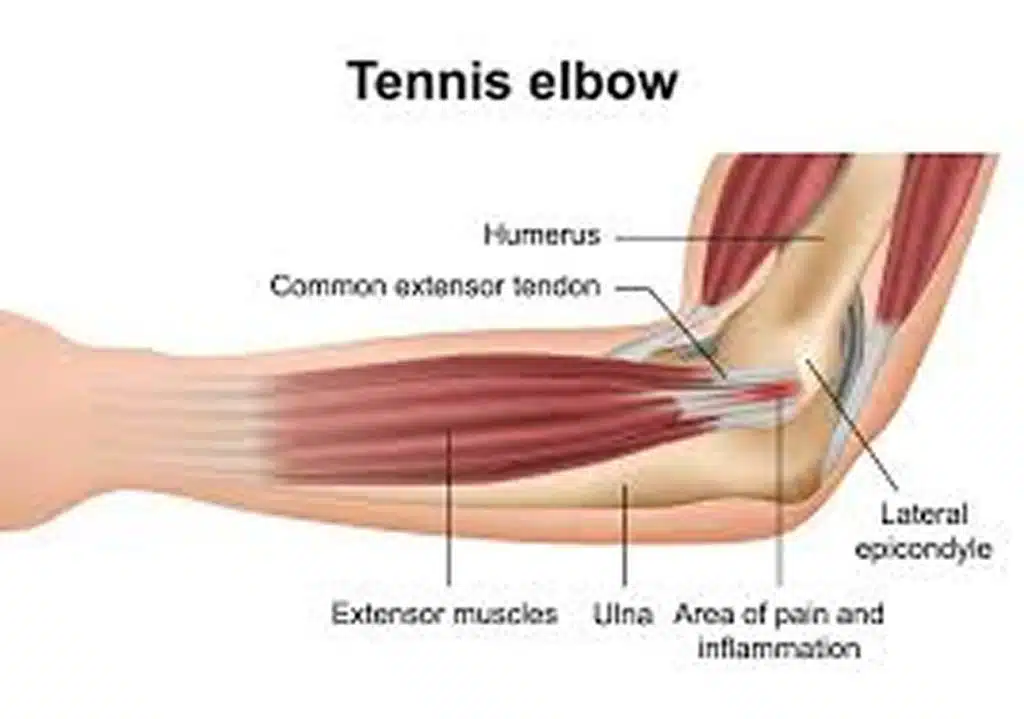
Tennis elbow, also called lateral epicondylitis, affects the tendons that attach the forearm muscles to the outside of the elbow. AAOS explains that the tendon most often involved is the extensor carpi radialis brevis, or ECRB. This muscle helps stabilize the wrist, especially when the elbow is straight and the hand is being used in a forceful or repetitive way.
The Orthobullets episode frames the problem as a high-yield overuse condition of the shoulder and elbow world, and that is a useful way to think about it clinically. The tendon gets overloaded, microscopic damage builds, and the tissue starts reacting with pain, tenderness, and weaker gripping ability. Sometimes people feel it after sports. Other times it shows up because of tools, keyboards, landscaping, painting, lifting, repetitive wrist extension, or a workout pattern that loads the forearm more than expected.
That is why the label tennis elbow can be misleading. In Jupiter, the patient may be a tennis or pickleball player, but it may just as easily be a contractor, golfer, mechanic, office worker, parent carrying gear, or someone whose gym routine includes lots of gripping and pulling. The pain pattern matters more than the stereotype.
One frustrating part of tennis elbow is that the pain often seems small until it starts affecting ordinary life. The outside of the elbow may feel tender at first, then a person notices that pouring coffee hurts, picking up a backpack feels sharp, or a strong handshake is suddenly unpleasant.
AAOS notes that common symptoms include:
Because symptoms build gradually, many people keep pushing through them longer than they should. They change how they lift, compensate with the shoulder, or reduce activity without really solving the problem. Over time, that can make the tendon more irritable and daily function less reliable.
AAOS describes tennis elbow as degeneration or microtearing of the tendon due to overuse. The ECRB tendon is especially vulnerable because of the way it functions and because it can rub near bony structures as the elbow bends and straightens. The result is repeated mechanical stress in an area that does not always recover quickly when the same motion keeps happening again and again.
This is why the problem is common in more than just racquet sports. AAOS specifically points to painters, plumbers, carpenters, auto workers, cooks, and butchers as examples of occupations where repetition and lifting demands can contribute. The same logic applies to many modern activity patterns too, including strength training, repetitive computer use combined with gripping tasks, paddle sports, home renovation work, and yard projects.
The Orthobullets episode reinforces the same core idea, that lateral epicondylitis is fundamentally a repetitive overload problem. That means treatment should not only chase pain relief. It should also account for what is repeatedly provoking the tendon.
A common pattern is that the elbow settles down when activity is reduced, then flares the moment a person returns to normal movement. That does not necessarily mean the case is severe. It often means the tendon is still sensitive and the underlying load problem has not been corrected.
Tendon pain usually does not behave like a simple bruise. The tissue may be less inflamed than people assume and more irritated by poor tolerance to repeated stress. That is one reason a few days off can help temporarily but may not create lasting change. If a patient goes right back to repetitive gripping, wrist extension, forceful lifting, or sport-specific movement, symptoms can return fast.
For many people in Jupiter, this is the point where frustration sets in. They feel just good enough to restart the activity they care about, then the elbow reminds them it is not actually ready yet.
A good evaluation is not just about confirming that the outside of the elbow hurts. It is about making sure the pain pattern truly fits tennis elbow and not another condition that can mimic it.
AAOS notes that diagnosis includes understanding how symptoms developed, what occupational or recreational patterns may be contributing, and what activities reproduce the pain. During the exam, clinicians often press on the lateral epicondyle and may ask the patient to straighten the wrist or fingers against resistance with the elbow straight. If this reproduces pain, it supports the diagnosis.
That sounds simple, but it is useful because elbow pain can come from different sources. Nerve compression, arthritis, neck-related pain, other tendon problems, and joint irritation can all change what treatment should look like. A real evaluation helps sort that out instead of assuming every sore outer elbow is the same thing.


Imaging is not always required for straightforward tennis elbow, but AAOS explains that it can be helpful when the diagnosis is unclear or when other causes of pain need to be ruled out.
X-rays may be used to look for elbow arthritis or other structural issues. MRI may be used to assess tendon damage or to check whether symptoms might be related to a neck problem such as a herniated disc or arthritic change. AAOS also notes that EMG testing may be used when nerve compression is a concern because nerve symptoms around the elbow can sometimes overlap with tennis elbow complaints.
In practical terms, the value of imaging is not just getting a picture. It is making sure treatment is being aimed at the right problem, especially when symptoms have been stubborn, unusual, or more limiting than expected.
AAOS reports that approximately 80 to 95 percent of patients improve with nonsurgical treatment. That is encouraging, but it does not mean recovery is automatic. It means that the right plan, applied consistently enough, can work very well for many people.
Non-surgical care may include:
The goal is not simply to numb the area. It is to reduce irritation while restoring the tendon’s ability to tolerate load again. That often means changing how the forearm is being stressed during work, workouts, and recreation while still keeping the rest of the body active.
AAOS describes tennis elbow as degeneration or micro-tearing of the tendon due to overuse. The ECRB tendon is especially vulnerable because of the way it functions and because it can rub near bony structures as the elbow bends and straightens. The result is repeated mechanical stress in an area that does not always recover quickly when the same motion keeps happening again and again.
This is why the problem is common in more than just racquet sports. AAOS specifically points to painters, plumbers, carpenters, auto workers, cooks, and butchers as examples of occupations where repetition and lifting demands can contribute. The same logic applies to many modern activity patterns too, including strength training, repetitive computer use combined with gripping tasks, paddle sports, home renovation work, and yard projects.
The Orthobullets episode reinforces the same core idea, that lateral epicondylitis is fundamentally a repetitive overload problem. That means treatment should not only chase pain relief. It should also account for what is repeatedly provoking the tendon.
A common pattern is that the elbow settles down when activity is reduced, then flares the moment a person returns to normal movement. That does not necessarily mean the case is severe. It often means the tendon is still sensitive and the underlying load problem has not been corrected.
Tendon pain usually does not behave like a simple bruise. The tissue may be less inflamed than people assume and more irritated by poor tolerance to repeated stress. That is one reason a few days off can help temporarily but may not create lasting change. If a patient goes right back to repetitive gripping, wrist extension, forceful lifting, or sport-specific movement, symptoms can return fast.
For many people in Jupiter, this is the point where frustration sets in. They feel just good enough to restart the activity they care about, then the elbow reminds them it is not actually ready yet.
A good evaluation is not just about confirming that the outside of the elbow hurts. It is about making sure the pain pattern truly fits tennis elbow and not another condition that can mimic it.
AAOS notes that diagnosis includes understanding how symptoms developed, what occupational or recreational patterns may be contributing, and what activities reproduce the pain. During the exam, clinicians often press on the lateral epicondyle and may ask the patient to straighten the wrist or fingers against resistance with the elbow straight. If this reproduces pain, it supports the diagnosis.
That sounds simple, but it is useful because elbow pain can come from different sources. Nerve compression, arthritis, neck-related pain, other tendon problems, and joint irritation can all change what treatment should look like. A real evaluation helps sort that out instead of assuming every sore outer elbow is the same thing.
AAOS points out that physical or occupational therapy can be especially helpful, including specific exercises to strengthen the forearm muscles. Therapists may also use modalities like ultrasound, ice massage, or muscle stimulation, but the bigger value is usually a structured plan for rebuilding movement capacity.
That matters because tennis elbow is often aggravated by how force is transferred through the wrist, forearm, and elbow. If the muscles fatigue too quickly, if technique is poor, or if the tendon is reloaded too aggressively after pain settles down, symptoms can linger.
A thoughtful rehabilitation plan can help patients rebuild gripping tolerance, adjust movement patterns, improve forearm endurance, and return more gradually to lifting, racquet sports, golf, typing-heavy work, or manual labor. For many patients, the difference between a long-running problem and a turning point is not one dramatic treatment. It is consistent load management done well.
Forearm straps or braces can help in selected cases by reducing strain on the involved tendon. AAOS notes that a brace centered over the back of the forearm may relieve symptoms by giving the muscles and tendons more rest. This does not fix the whole problem on its own, but it can be useful as part of a larger plan.
AAOS also discusses steroid injections, platelet-rich plasma, and shock wave therapy. Steroid injections may reduce symptoms because they are powerful anti-inflammatory medications, but AAOS warns they should be used sparingly because excessive use may weaken the tendon attachment over time. That is an important tradeoff and one reason quick pain relief is not the only decision point.
Platelet-rich plasma has shown mixed but sometimes promising findings. Shock wave therapy is still considered experimental by many clinicians, though some sources suggest it may help. The key is that not every patient with tennis elbow needs every treatment option discussed online. The most useful next step depends on how long symptoms have been present, how the tendon is behaving, and what conservative care has already been tried.
Surgery is usually reserved for cases that do not respond after a meaningful course of nonsurgical care. AAOS says surgery may be considered if symptoms do not improve after 6 to 12 months of conservative treatment.
Most surgical procedures involve removing diseased tendon tissue and reattaching healthier tendon back to bone. AAOS describes both open and arthroscopic approaches, along with risks such as infection, nerve or blood vessel injury, prolonged rehabilitation, loss of strength, loss of flexibility, and the need for further surgery.
That does not mean surgery is a bad option when it is truly needed. It means the decision should be made carefully, with a realistic view of rehab and expected recovery. Most patients would rather avoid it if a strong nonsurgical plan can get them back to daily life and activity.
Most people are not asking for a long anatomy lesson. They want direct answers to practical questions such as:
Those are the right questions. They focus on function, timing, and what actually changes the day-to-day experience of the injury.
If the outside of your elbow keeps hurting, if grip strength feels unreliable, or if the pain is changing how you work out or work through the day, it is worth getting assessed. The longer a person spends cycling through internet tips, random braces, short rest periods, and repeated flare-ups, the easier it is to lose time and confidence.
The next step does not have to mean a procedure. It can simply mean getting a clear diagnosis, understanding what is driving the overload, and building a plan that fits your real demands. For one patient, that may mean therapy and activity modification. For another, it may mean deeper evaluation after months of stubborn symptoms. Either way, the goal is the same, getting the elbow dependable again.
No. Tennis elbow often comes from repetitive gripping or wrist extension demands and is common in both sports and work activities.
Often, yes. AAOS reports that most patients improve with nonsurgical treatment when the problem is managed well.
The irritated tendon helps support wrist and forearm function, so pain and tendon overload can make gripping feel weaker or less reliable.
If pain is persistent, affecting function, or failing to improve with reasonable conservative care, an orthopedic evaluation is worth considering.
Tennis elbow can seem minor at first, but it becomes a real problem once pain starts affecting grip, lifting, sport, work, or simple daily tasks. Tennis elbow treatment in Jupiter should focus on identifying the true pain source, reducing repetitive tendon overload, rebuilding strength and tolerance, and using the least invasive treatment path that fits the actual problem. Many patients improve well without surgery when the condition is addressed early and managed with a realistic plan.
If pain on the outside of your elbow` is not settling down, call Palm Beach Regenerative Orthopedics or schedule a visit online for a clear next step. tennis elbow treatment jupiter, florida palm beach regenerative orthopedics.